
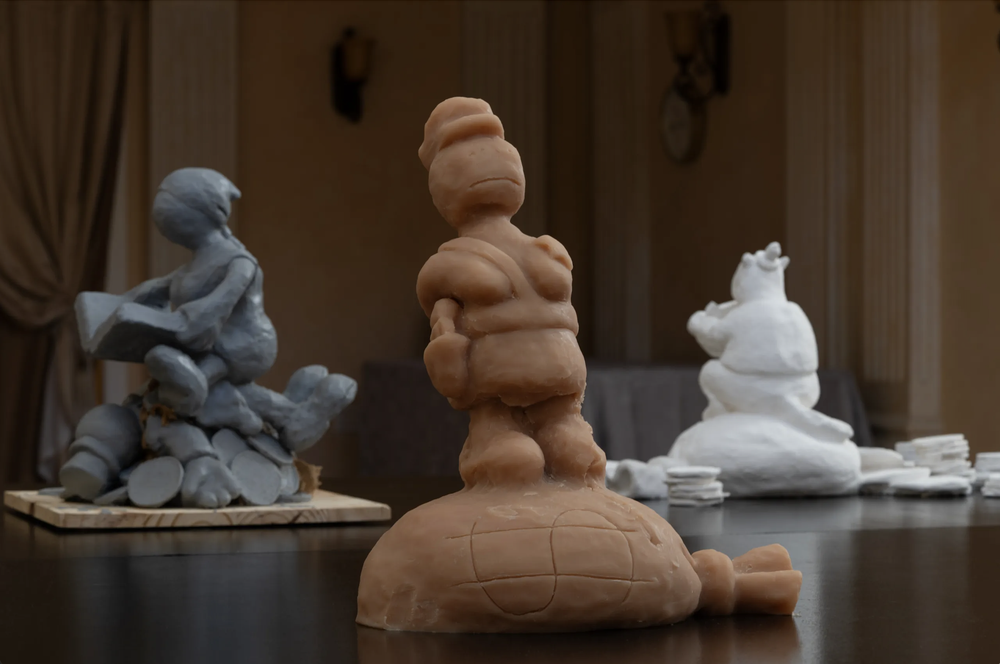
ENSNARED IN THE DOLDRUMS of January, I arrived at the Aristotle Psychological Facility in Astoria for an appointment. My mind, though enfeebled by New Year’s celebrations, was fine; I’d traveled to Queens to see Jeffrey Joyal’s “my Life Underground” at Gandt. For this exhibition, the gallery left its longtime home in a basement for a column-laden miniature ballroom in a clinic up the block, complete with a wrought-iron chandelier and ghostly portrait hanging above the crown molding. Walking through the lobby to the exhibition room, I passed by an empty suggestion box entreating patients to “rate their therapist.” Perhaps the worldwide nervous breakdown hadn’t made it to Astoria yet.
The exhibition featured eleven reproductions of Tom Otterness’s public art series “Life Underground,” 1998–2001, little bronze sculptures of twentieth-century immigrants, commuters, and tycoons installed on the floor of the subway station at Fourteenth Street and Eighth Avenue. To make the copies, Joyal completed illegal gonzo casts or scans of the original works in situ, rendering them in plaster, rubber, and clay. While the exhibition’s text contextualized Joyal’s sculptures as a celebration of New York’s downtrodden straphangers, the show succeeded better in its meditation on privatization and theft. Unlike the cast bronze appropriations of Marcel Duchamp’s 1917 Fountain that Sherrie Levine made in the 1990s, Joyal’s copies isolate their source material from their specific physical context. At Fourteenth Street, the statues line the benches and ground and look upward; walking over them, you catch their eyes as you would another commuter’s, sharing a mutual recognition of shared circumstances. When arranged atop Gandt’s hip-height gallery table, the little characters felt individual and aloof. Rather than attempt to re-create their public context, Joyal embraces the figures’ isolation, facing them away from one another and denying the viewer the narrative coherence and public interplay of the original series.
Joyal’s co-option of a public sculpture that already ostensibly belongs to every train-riding New Yorker is a fitting symbol for the Trump era, in which every public resource is seen as a potential vehicle for the extraction of private profit. Accordingly, the artist plays up the garishness of the gesture by re-creating Otterness’s cartoonish money bag and dollar-sign-faced miser in plaster with a chintzy bronze-like chrome plating. One imagines these brittle figures will crack and crumble long before the subway’s solid bronze originals have so much as tarnished. Like the Michelangelo copies in the lobby of Caesar’s Palace, they gleefully trade in kitsch, not durability. This is not the sculptures’ failure, but their success: As intentionally degraded reproductions of the original characters, the sculptures highlight the pitfalls of isolation, directing the viewer back to the interactivity of the public stage as the real source of meaning.
With decay on the mind, I headed to Mitchell Kehe’s “Bonded by the Spirit of Doubt” at 15 Orient in TriBeCa, a vast installation of scruffy canvases and assemblage sculptures made of trash. In Untitled 1 (Bonded by the spirit of doubt), 2026, an irregular shape doubles across a wide horizontal canvas, once as a painted and outlined figure above the silver background, once as a void of raw fabric. In this and other works, shapes appear and are repeated only to fail in their reconstruction, lingering as unresolved shadows. In Untitled 11 (Bonded by the spirit of doubt), 2026, for example, acrylic, oil, and Aquacote alternately cover and seep into the work’s linen surface. Blue stains of pigment trickle into the porous fabric, only for Kehe to seal the surface elsewhere with thick, matte washes of paint. On the floor in front of the painting, the sculpture First Layer of Revelation, 2026, forms a low wall from two boards taped around a haphazard collection of painting equipment, propped off the ground by uneven piles of books, cardboard, and trash. Like the show’s other works, it has a charming precariousness, pairing frail, reclaimed objects in an improbably steady equilibrium.
Unlike Kehe’s fragile found-object constructions, the paintings by Clémence de La Tour du Pin on view a few blocks away at Derosia allude to eternity, suggesting desiccated fossils and petrified matter. Hanging in the main gallery space are a group of three supremely eerie paintings, their attenuated forms constructed from oil paint, pigment, wax, and silk on linen. The largest of the three, Untitled, 2025, is two and a half inches tall but nearly twenty feet wide, recalling an enormous tusk or splintered bone. Its evocation of an archaeological specimen is only heightened by the use of asphalt to endow some of the painting’s surface with a hazy tar-pit char. The other two untitled asphalt paintings on display are slightly smaller and squared, and feature umbrella ribs on their surfaces in bent and broken lines, as if compressed over millennia by sedimentary pressure. Serving as a counterpoint to the human body, the umbrella skeleton’s failure to decompose invokes a prolonged melodrama: Our banal trinkets will haunt the planet long after we are gone.
Elsewhere in Chinatown, John Duff’s show at Reena Spaulings surveys sixty years of the artist’s resin, fiberglass, and concrete sculptures. The oldest examples of stretched and hung amber-colored forms were like fossils, comprising cracked and bowed leaves of wax calcified into fragile plates. Untitled, 1968, for instance, ties together bruised and withered fiberglass fragments into a flat gorget. Each shard is warped and stiffened like leather left in the sun. While Duff (whose work often features torched and damaged materials) almost certainly tampered with the fiberglass in the ’60s, the collar carries the signs of age: wrinkled surface, frayed edges. Untitled, 1970, consists of four thin intersecting fiberglass panels, covered by four identical panels propped up into a low pyramid and held together with metal piercings. Tentlike but without poles or support, the structure holds itself aloft through its own geometry. Neither fiberglass sculpture degrades under such pressure, instead flexing to accommodate strain. In the contrasting work Untitled, 2025, a thin bicycle chain forms the boundary of a concrete plate, held aloft by a tripod growing out from the shape. Metal screws puncture the chain and drive into the surface, indicating that the chain (which has already hardened to bond with the material) might burst from the stress of the internal form pushing outward. Here, the malleability of Duff’s wax works is replaced by the uncompromising rigidity of concrete. His coarse application of the material begs the question: If the sculptures cannot bend, when will they break? The concrete works—including the sculpture Untitled, 2024, which is attached to a wall by a knotted single string—suggest that dissolution will come all at once, when the balanced forms collapse in a single catastrophic moment.
As frayed as our collective strings might seem, things still haven’t come crashing down. Perhaps it’s a function of the midwinter freeze, but January’s meditations on pressure seem to resolve in various states of stasis, accommodating rather than folding to stress. Should the strain of this abominable new year soon prove too much to bear, it’s a relief to know there’s a therapist in Queens with plenty of availability.